.png?width=1036&height=511&name=EPSI%20LOGO%20COLOR%20(1).png "EPSI Engineered Services and Products Inc")
When production targets keep climbing but quality standards won’t budge, you need smarter systems, not just faster conveyors. If you’re looking to improve powder coating throughput without sacrificing finish consistency, the solution lies in optimizing the entire process, not just one station.
High-volume powder coating lines operate in demanding environments where heat, chemistry, geometry, and scheduling all intersect. Whether you serve automotive, aerospace, medical, or industrial manufacturing, sustainable gains come from engineering improvements that reduce variability, increase density, and eliminate waste across the line.
1. Identify and Eliminate the True Bottleneck
It’s easy to assume the spray booth is slowing you down. In reality, bottlenecks often appear upstream or downstream.
Common culprits include inconsistent pretreatment dwell times, dry-off ovens that can’t keep pace with line speed, cure ovens with uneven heat zones, inefficient hanging methods, and manual inspection steps that interrupt flow.
A thorough process mapping audit reveals where work-in-progress accumulates. Once you identify the actual constraint, you can address it directly instead of increasing line speed and amplifying existing problems.
3. Increase Transfer Efficiency with Proper Gun Calibration
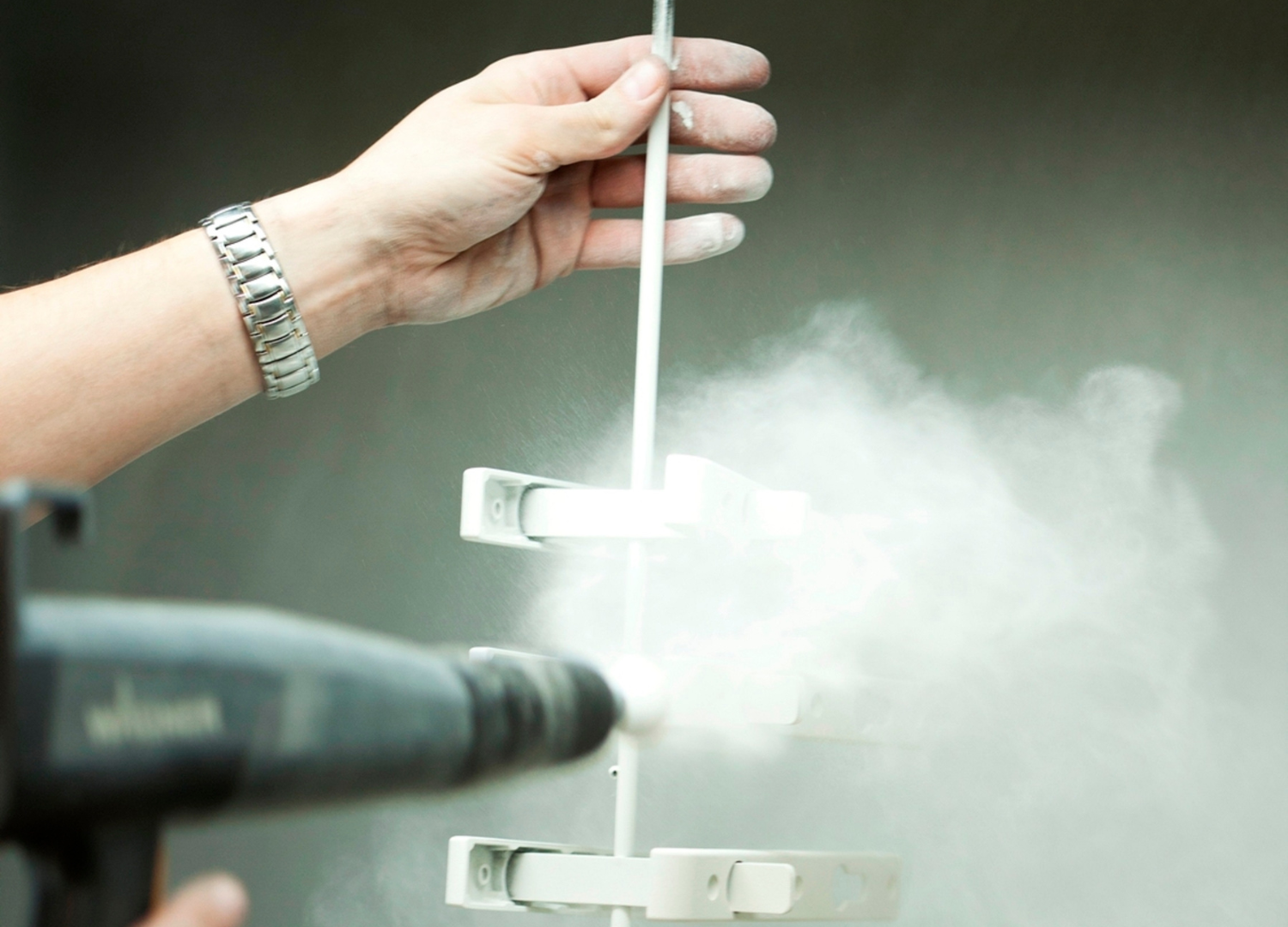
Transfer efficiency determines how much powder adheres to the part versus ending up in reclaim. When TE is low, operators compensate with extra passes, which slows production.
To improve TE:
- Calibrate guns regularly
- Adjust kV and microamps for specific geometries
- Ensure consistent grounding
- Use programmable recipes for repeatable settings
Higher transfer efficiency means fewer passes, shorter cycle times, and reduced material waste, all of which support higher throughput without compromising finish quality.
4. Stabilize Pretreatment to Reduce Rework
Throughput isn’t just about speed. It’s about usable output. Adhesion failures and surface defects caused by inconsistent pretreatment lead to costly rework that erases production gains.
Stable pretreatment requires tight control over chemical concentrations, bath temperatures, pH, and dwell times. Automated dosing and sensor monitoring can eliminate operator variability. When pretreatment is consistent, downstream defects drop, allowing you to maintain steady line velocity with confidence.
5. Improve Cure Oven Consistency
If your cure oven has cold spots or fluctuating profiles, you’re forced to slow the line to ensure proper curing. That safety margin reduces overall capacity.
Thermal profiling, airflow balancing, and improved recirculation help maintain uniform temperatures across the load. Sealing air leaks and validating ramp and soak curves ensures thin and thick components cure properly at optimal speeds.
When cure profiles are predictable, you can safely run at higher conveyor speeds without risking under-cured finishes.
.png?width=1200&length=1200&name=Wheel-Masking-Kit_EPSI%20(3).png)
.png?width=1200&length=1200&name=Wheel-Masking-Kit_EPSI%20(1).png)
7. Schedule by Part Family to Minimize Changeovers
Mixed runs with constant parameter adjustments slow everything down. Instead of processing jobs in arrival order, group them by substrate type, coating thickness, geometry, cure requirements, or color.
A part-family scheduling strategy reduces gun adjustments, minimizes oven changes, and decreases downtime between batches. Fewer transitions mean smoother flow and more consistent output.
8. Implement In-Line Quality Monitoring
Stopping production to investigate defects disrupts throughput more than catching issues early.
In-line film thickness gauges, infrared cure verification tools, conveyor speed monitoring, and automated visual inspection systems allow you to detect deviations in real time. Instead of discovering problems at final inspection, you address them immediately.
Quality checks should support flow, not interrupt it. Smart monitoring protects production speed while maintaining standards.
9. Improve Line Layout and Material Flow
Throughput losses sometimes have nothing to do with coating equipment. Poor workstation layout can slow operators significantly.
Evaluate rack staging areas, forklift paths, loading station ergonomics, and WIP storage zones. Even small adjustments that reduce walking distance or reposition frequently used racks can improve line velocity.
Lean layout principles eliminate wasted motion and create smoother transitions between stages.
10. Invest in Continuous Operator Training
Operators influence throughput more than any machine. Proper grounding techniques, consistent hanging practices, correct spray patterns, and understanding cure profiles all affect speed and quality.
Ongoing training programs build consistency across shifts. When operators understand how each variable impacts downstream results, they make better real-time decisions that support throughput goals.
Facilities that prioritize education typically see both higher productivity and lower reject rates.